There is a tendency to view creativity in advertising in Vietnam as repetitive. This perception does not stem from a lack of ideas, but from the overuse of familiar formats that have become predictable over time.
What is often overlooked is where creativity actually operates. It is not always in disruption, but in the subtle reworking of what already exists.
These three creative ad campaigns reflect where creativity in advertising stands in Vietnam today: not in chasing novelty, but in challenging ingrained habits, engaging with real cultural tensions, and reconsidering how messages are shaped and delivered within familiar formats.
#1 PNJ – Turning “Trân Quý” into a Language of Emotion for Tết
PNJ’s campaign masterfully revived the value of “trân quý” (preciousness) in Vietnamese Lunar New Year (Tết) culture, transforming gold from a material product into a language of meaningful giving.
By focusing on human emotions and culturally resonant behaviors, PNJ elevated its brand beyond traditional advertising in Vietnam, showcasing how thoughtful creative ad campaigns can connect deeply with audiences.

Contextual Relevance and Timing
Tết is not only a peak season for advertisement in Vietnam, it is also one of the few moments when people pause and reflect on what truly matters.
But reflection during Tết is not purely sentimental. It comes with a quiet tension that sits beneath the surface.
In Vietnamese culture, family roles are deeply understood but rarely verbalized: Parents provide without needing recognition, older siblings step in without being asked, and adults carry responsibility as something natural, not something to be acknowledged out loud.
These contributions are not invisible, but they are normalized to the point where they no longer get called out.
Gold as a Way to Say What People Don’t
From that insight, gold takes on a different role. It is no longer positioned purely as a valuable product, but as a way to express appreciation.
In the context of creative ad campaigns in the jewelry category, this is a subtle but important shift. The product is not leading the story; it fits into a moment that already exists in people’s lives.
That is what makes the connection feel natural. Gold becomes a medium for communication, especially for things that are felt but rarely said.
Where Creativity in Advertising Shows Up: From Story to Culture
The platform does not stay at the level of messaging. It is carried through a set of executions that keep the idea visible and relatable across touchpoints.
The most defining piece is the “Việc lớn” music video featuring Đen Vâu. Instead of building a typical festive narrative, the MV centers on the quiet weight of adulthood. Responsibility, routine, and the kind of effort that rarely gets acknowledged. It is a direction that feels closer to real life than the usual polished Tết stories.
This is where creativity in advertising shows up. The MV does not force the product into the story. It builds an emotional context first, then lets the brand sit within it. That choice is what gives the content replay value and makes it easier to share.
When Advertisement in Vietnam Actually Makes Insight Actionable
The execution also understands distribution. The MV drives reach, but shorter cuts, social edits, and conversation-led content extend the idea into formats people actually engage with daily.
What makes this approach work is the balance. The message is clear enough to travel, and the tactics are designed to let people encounter it naturally.
That is where creativity in advertising becomes relevant in advertising in Vietnam. Not by amplifying emotion, but by making an unspoken truth visible and giving people a way to act on it.
#2 “Sum Vầy” Reworked: How Advertising in Vietnam Adapts to a More Mobile Reality
While PNJ builds on cultural tension, Viettel’s “Dân chơi 5G – Tới bến tới bờ” TVC starts from a pattern in advertising in Vietnam that has been repeated to the point of habit: the journey home.
Over time, that narrative has become a quiet standard for people to measure themselves against every Tết. The gap sits there: Not everyone can make that trip, but the expectation to do so doesn’t go away.

So The Friday and VTT worked on that pressure point directly. They don’t ask “how do we make this more touching?” but “what happens when this doesn’t hold true anymore?”
That’s creativity in advertising. Not in deepening the same feeling, but in adjusting the behavior the category has been reinforcing.
Reframing “Sum Vầy” Within a Modern Context
From that insight, the meaning of “sum vầy” is adjusted rather than replaced.
Traditionally, it is tied to a fixed moment: returning home. In this TVC, it becomes flexible: connection can happen through movement, not just arrival.
The idea “tới bến tới bờ” introduces an alternative logic:
- Connection is not location-dependent
- Reunion is not one-directional
In the context of advertising in Vietnam, this reflects a shift in lifestyle. Mobility, work, and distance are now part of everyday life, making the traditional model of reunion less universally applicable.
Reversing the Way Tết Creative Ad Campaigns Move
The execution follows this shift in thinking:
- A journey that moves outward rather than returning
- A protagonist who initiates connection rather than waits for it
- A tone that prioritizes energy and progression over nostalgia
Among creative ad campaigns, this demonstrates how execution can directly reflect a change in perspective, rather than simply delivering a message.
Two Directions, One Proof of Creativity in Advertising in Vietnam
If the PNJ campaign makes unspoken appreciation visible, Viettel addresses a different gap:
- PNJ: People feel but don’t express
- Viettel: People want to act but face constraints
Both operate within the same cultural moment, but respond to different tensions within it.
This contrast highlights how creativity in advertising within advertising in Vietnam is not limited to emotional storytelling. It can also come from re-evaluating the assumptions behind widely accepted narratives.
#3 “Đề Kháng Lỗi”: When Creativity in Advertising Is Inspired by Failure
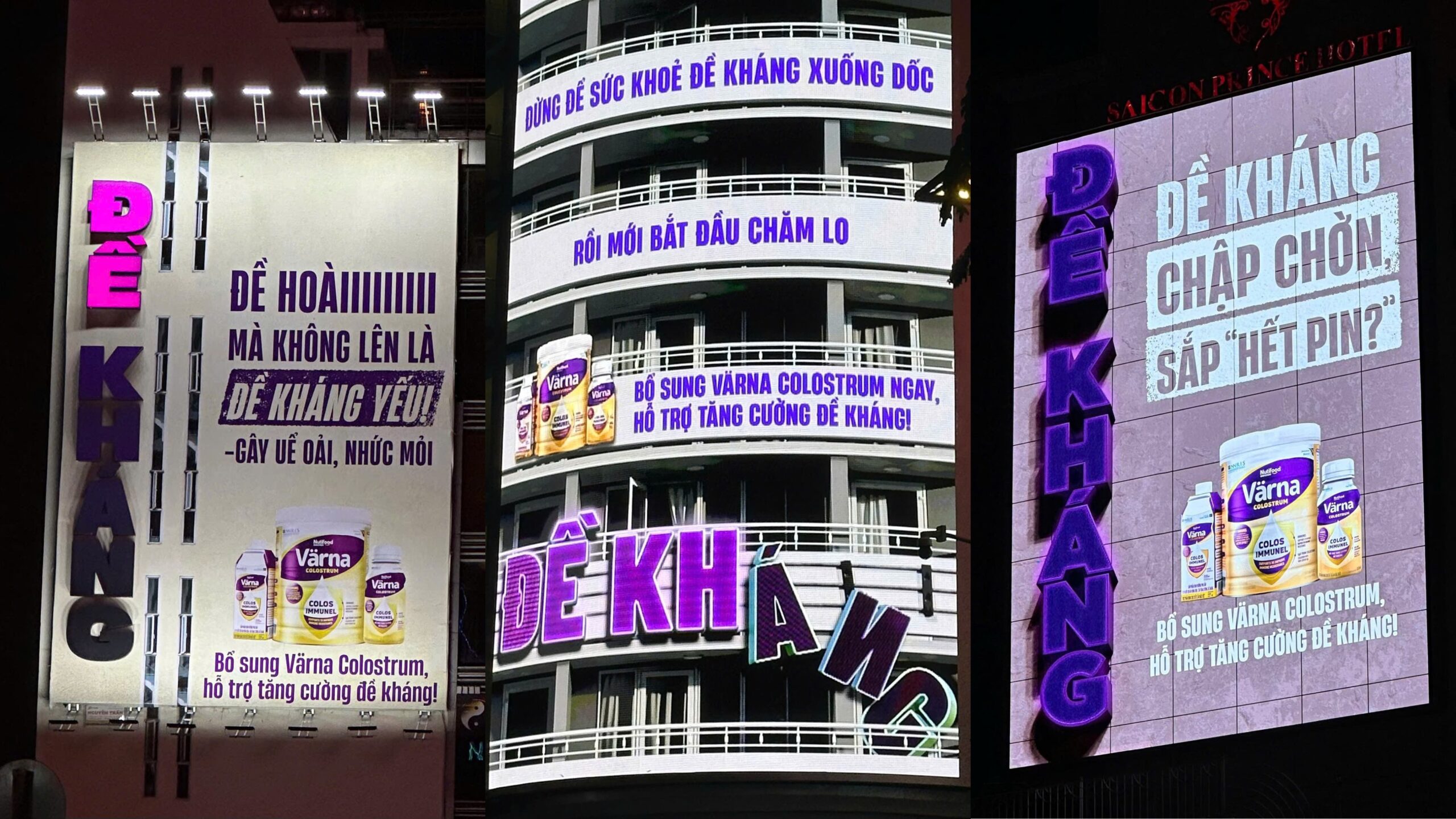
By using the messages “Đề kháng lỗi khiến cả người ê ẩm” and “Đề hoài không lên là đề kháng yếu”, the campaign turns a familiar pun into a real-world cue. The “malfunctioning” billboards do the job of making weak immunity feel immediate, which is what lifts it above typical creativity in advertising in Vietnam.
1. Visualizing the “Failure”
Usually, brands want their billboards to look perfect, shiny, and expensive. By intentionally making the billboards look like they are “failing to start”; Purpose.Ant, a creative agency in Vietnam, chose something counter-intuitive: Billboards that are flickering, half-lit, or “stuck” to mirror the frustration of a motorbike that won’t đề (kickstart).
You aren’t just reading about a weak immune system; you are looking at a giant, physical representation of what it feels like to be “ê ẩm, mệt mỏi” (aching/sluggishness).
2. Contextual Placement
Imagine being stuck in heavy traffic, breathing in fumes, and looking up to see a billboard that looks like it’s “struggling” to stay on.
The message “Đề hoài không lên là đề kháng yếu” hits home because, in that moment, your bike is idling and your own body is likely feeling the drain of the commute. The billboard “breaks” exactly as the audience feels “broken.”
For a category that usually explains itself with ingredients and functions, this shows how creativity in advertising can make the message felt first, understood second.
3. Breaking the “Fourth Wall” of Advertising in Vietnam
Most advertisement in Vietnam is “assembled” because it stays literally within the box. They are 2D images with a logo. This campaign “broke” the box:
By using mechanical elements (flickering lights, distorted visuals) to show the “lỗi” (error), Purpose.Ant forced the brain to solve the puzzle: “Why is that ad broken? Oh, ‘Đề không lên’… just like my energy right now.”
This example proves that creativity in advertising isn’t just in the punchline; it’s in the synchronization of language, hardware, and the visceral exhaustion of the audience.
It transforms a functional vitamin ad into a cultural moment, and an unforgettable creative ad campaign in Vietnam that people want to share because it feels relatable, not salesy.
Creativity in Advertising Is Go the Extra Mile. And It’s Not What You Think
From an agency perspective grounded in consistency, these creative ad campaigns are strong for reasons that are not immediately obvious:
None of them try to do everything.
Instead, they identify a single tension and follow it through with clarity. Each operates within familiar patterns in advertising in Vietnam, but pushes just far enough to shift how those patterns are experienced.
That’s what we mean by discipline. In other words, it’s Go The Extra Mile and taking an idea further than most are willing to. Again and again. Until it holds.
FAQs
1. Why does creativity in advertising fail although the idea looks strong?
Creativity in advertising typically fails not because the idea is weak, but because it is misaligned with execution reality (media, timing, or audience context).
In Vietnam, this gap is more pronounced as attention spans are short and content is algorithmically filtered. A strong idea must be modular, adaptable, and instantly engaging within the first 3 seconds, otherwise it loses effectiveness regardless of its conceptual strength.
2. What are the most common misconceptions about creativity in advertising?
One major misconception is that creativity equals originality alone. In reality, effective creativity in advertising is about relevance + timing + execution fit.
Other misconceptions include:
- “More creative = more complex” → often the opposite is true
- “High budget guarantees impact” → in Vietnam, low-budget but insight-driven campaigns often outperform
- “One big idea is enough” → modern campaigns require content ecosystems, not single executions
3. How do you evaluate whether a creative ad campaign is truly effective?
A capable creative agency in Vietnam should be evaluated on business impact, not just creative output.
Key indicators include:
- Ability to translate brand strategy into clear commercial outcomes
- Consistency between idea and execution across channels
- Evidence of campaigns driving engagement quality, not just reach
Many agencies can produce visually appealing work, but only a few can demonstrate how their creativity improves conversion efficiency or brand equity over time.
4. What separates scalable advertising systems from one-off advertisements in Vietnam?
One-off success depends on a single execution. Scalable systems depend on repeatable idea logic + continuous execution. In advertising in Vietnam, marketing subscriptions are helping brands move from one creative burst to:
- Ongoing content production and iteration
- Faster testing and optimization cycles
- Consistent messaging that builds long-term recall
Therefore, the subscription agency model turns creativity in advertising into an always-on system, not a one-time output.
5. Short-term metrics vs. long-term recall: What matters more for advertising in Vietnam?
Short-term metrics (CTR, conversions) show immediate results, but they often decay quickly without strong brand memory. A memorable creative ad campaign builds mental availability, which lowers future CAC and improves performance over time.
A creative agency Vietnam will often optimize for both but long-term growth depends on how well creativity in advertising builds mental availability, not just interaction.